
Basic Maintenance KPI Calculator
Quickly calculate MTTR, MTBF, PMP, OEE, MTTF, unplanned downtime, failure rate, mean maintenance cost, Wrench Time, and MC/RAV. Each calculator displays the formula, validates input data, and returns results instantly.
Results are intended for reference and internal analysis. Standardize the time period, units of measurement, and data sources before comparing KPIs.
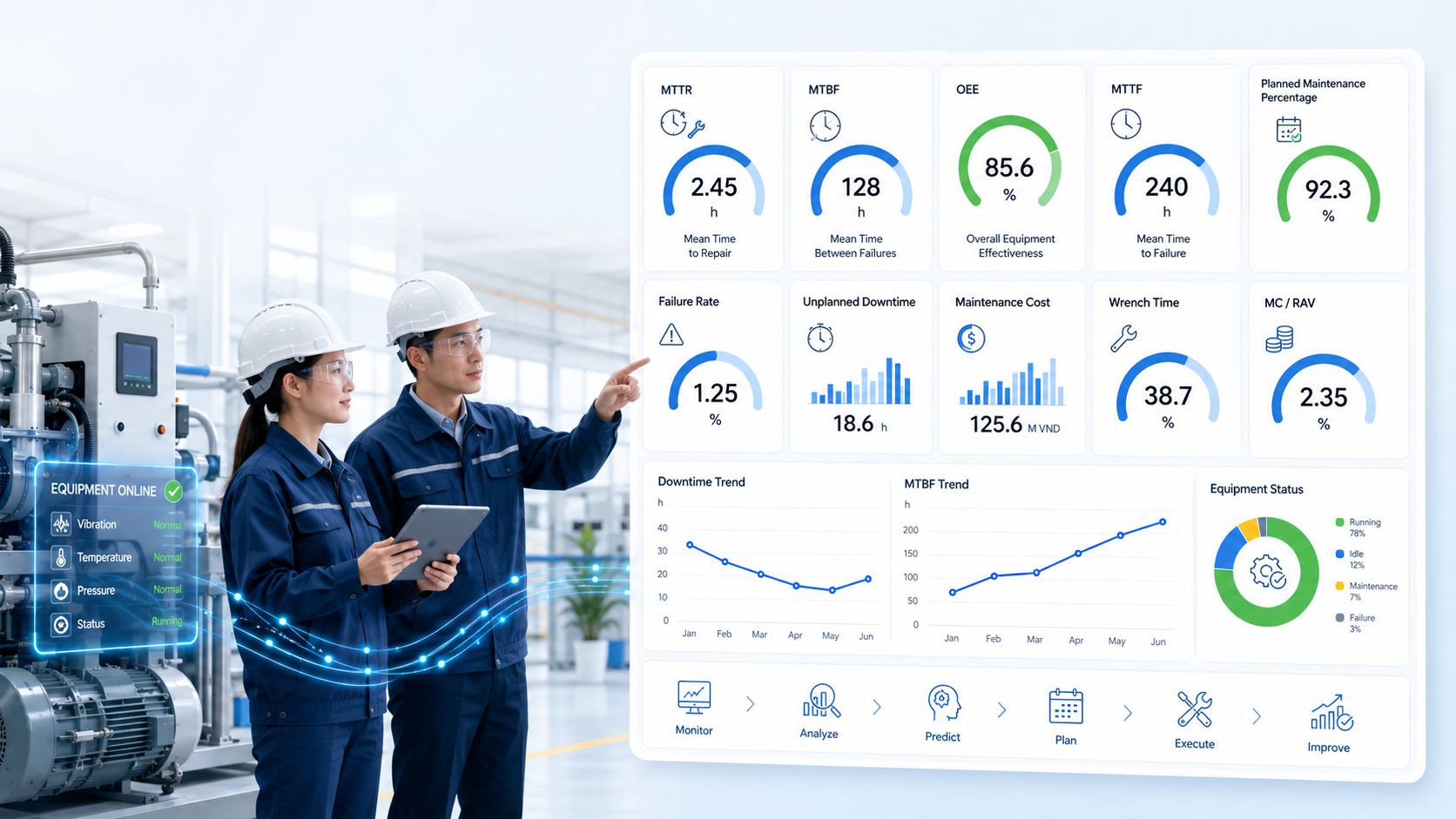
What Do Maintenance KPIs Measure?
Maintenance KPIs are quantitative metrics used to track equipment reliability, recovery speed, maintenance proactivity, production effectiveness, and asset costs. A KPI is meaningful only when input data is recorded consistently.
Reliability and Maintainability
MTBF, MTTF, and Failure Rate reflect failure frequency, while MTTR reflects the time required to restore equipment.
Operational Effectiveness
OEE combines availability, performance, and quality, while Unplanned Downtime indicates the portion of downtime that occurs outside the plan.
Proactivity and Cost
PMP, Wrench Time, MMC, and MC/RAV help evaluate the work mix, time productivity, and maintenance cost levels.
10 Maintenance KPIs and Their Uses
The table below helps you select the right metric before entering data. A single KPI should not be used to assess overall maintenance performance.
| KPI | Meaning | Result Unit |
|---|---|---|
| MTTR | Average repair time per repair event. | Hours/repair |
| MTBF | Average operating time between failures for repairable equipment. | Hours |
| PMP | Share of planned maintenance hours in total maintenance hours. | % |
| OEE | Overall equipment effectiveness based on availability, performance, and quality. | % |
| MTTF | Average operating time before failure, typically used for non-repairable items. | Hours |
| Unplanned Downtime | Downtime that was not planned. | Minutes |
| Failure Rate | Number of failures per unit of operating time. | Failures/hour |
| MMC | Average maintenance cost per maintenance activity. | Currency units/activity |
| Wrench Time | Percentage of time technicians spend directly performing maintenance work. | % |
| MC/RAV | Annual maintenance cost as a percentage of the replacement asset value. | %/year |
Calculate Basic Maintenance KPIs
Enter data for the same time period and using consistent units. The calculators run directly in your browser and do not send data to a server.
MTTR – Mean Time to Repair
Measures the average time required to complete a repair.
MTTR = Total downtime / Number of repairsMTBF – Mean Time Between Failures
Evaluates the reliability of repairable equipment.
MTBF = Total operating time / Number of failuresPMP – Planned Maintenance Percentage
Shows the proportion of maintenance hours that were planned in advance.
PMP = Planned maintenance hours / Total maintenance hours × 100OEE – Overall Equipment Effectiveness
Combines three components: availability, performance, and quality.
OEE = Availability × Performance × QualityMTTF – Mean Time to Failure
Typically applied to components or items that are not repaired after failure.
MTTF = Total operating time / Number of failuresUnplanned Downtime
Separates unplanned downtime from total downtime.
Unplanned downtime = Total downtime − Planned downtimeFailure Rate
Measures the number of failures per unit of operating time.
Failure Rate = Number of failures / Total operating timeMMC – Mean Maintenance Cost
Calculates the average cost per maintenance activity.
MMC = Total maintenance cost / Number of maintenance activitiesWrench Time – Direct Work Time Percentage
Reflects the share of time technicians spend directly performing maintenance work.
Wrench Time = Direct maintenance time / Total working hours × 100MC/RAV – Maintenance Cost to Replacement Asset Value
Compares annual maintenance cost with the replacement value of the maintained assets.
MC/RAV = Annual maintenance cost / Replacement asset value × 100Data note: Do not combine data from different scopes. For example, if total operating time is calculated monthly, the number of failures must also belong to that same month. For cost calculations, all values in the same calculation must use the same currency unit.
A 3-Step Process for Consistent KPI Calculation
Result quality depends directly on how data, measurement scope, and event-recording rules are defined.
Define the Scope
Select the equipment, production line, area, and time period to analyze. Clearly define which events count as failures or repairs.
Standardize Inputs
Use consistent time units, cost categories, and data sources. Remove duplicate or out-of-scope data.
Interpret Trends
Compare results over time, by equipment type, and by cause. Combine multiple KPIs instead of drawing conclusions from a single metric.
Maintenance KPI Calculation FAQ
The answers below clarify the scope of application and common data errors.
How are MTTR and MTBF different?
MTTR measures the average time required to repair and restore equipment. MTBF measures the average operating time between failures of repairable equipment. The two metrics should be monitored together to assess both reliability and recoverability.
Which components are used to calculate OEE?
OEE is the product of Availability, Performance, and Quality. The three percentages must be converted to decimals before multiplication, and the result is then converted back to a percentage.
Can MTBF or MTTF be calculated when the number of failures is zero?
Division by zero is not possible. If no failures have been recorded, clearly report the observation period and the status “insufficient events to calculate” instead of displaying an infinite value.
What should maintenance costs in MMC and MC/RAV include?
The cost scope must be defined consistently by the organization, such as labor, materials, outsourced services, or other related costs. Periods or facilities should not be compared when their cost scopes differ.
Can a monthly KPI be compared with an annual KPI?
Trends may be compared if the scope has been standardized and the effects of seasonality, production volume, operating time, and asset count are understood. Total values should not be compared directly when measurement periods and equipment utilization differ.
Do results from this tool replace in-depth maintenance analysis?
No. The tool performs calculations based on user-entered data. Evaluating causes, data reliability, target levels, and improvement decisions still requires operational context and the expertise of the organization using it.
Ready to Improve and Digitalize Maintenance?
Explore EcoMaint CMMS/EAM software to learn how to manage equipment, work, and maintenance data on a unified platform. The Vietsoft team is also ready to discuss your organization’s actual requirements.